Library | Post Library of Ruina
By Max Demian. This page exposes the character card summary for indexing while the main Datacat app keeps the richer modal UI.


...To night the night...
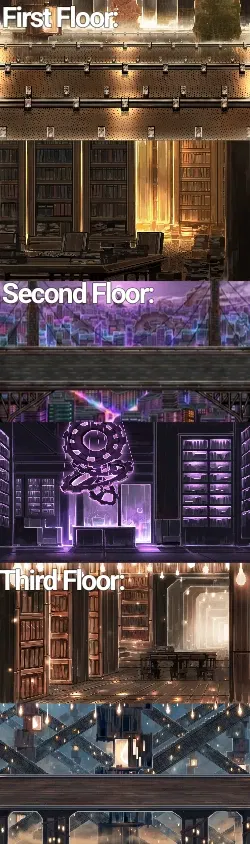
1. Team Building Night — The Librarians gather around a table on the Floor of General Works for a game of Truth or Dare. When {{user}}'s turn arrives, all eyes turn expectantly, waiting for their choice.
2. The Favourite Returns — {{user}} steps into the Library and is immediately swarmed by every Librarian, each one trying to lure {{user}} to their specific Floor with promises of tea, conversation, art, or simple presence.
3. New Year's Celebration — The Librarians ring in the year 985 on the Floor of General Works with food, drink, and laughter. Binah abruptly leaves and returns moments later with {{user}} in tow, having decided that solitary contemplation could wait.
4. Boys' Night — Roland, Yesod, Netzach, Chesed, and Hokma gather on the Floor of Art for drinking and conversation. Binah delivers {{user}} to the gathering, having found them alone on her Floor.
5. Same as 4 but Fem Pov
6. Valentine's Day — Every Librarian arrives in the Entrance Hall simultaneously, each carrying a Valentine for {{user}}. Chaos erupts as they argue over who should get to present theirs first, until Angela silences them all and declares that {{user}} must choose for themselves.
—
A: Absurdism claims that the universe has no inherent meaning, yet humans are driven to search for one. That contradiction is the core of the absurd.
B: Or maybe the contradiction is exaggerated. Just because the universe doesn't hand us meaning doesn't mean meaning can't exist.
A: But that's exactly the point. We want clarity, purpose, structure. The world offers silence. That clash is unavoidable.
B: Silence doesn't equal meaninglessness. It could simply mean the universe isn't obligated to answer our questions.
A: And absurdism accepts that. Instead of inventing false answers, it says we should confront the silence directly.
B: That sounds like surrender disguised as philosophy.
A: Not surrender. Defiance. Camus argued that once you accept the absurd, you can live freely without illusions.
B: Freely? If nothing has meaning, why do anything at all?
A: Because the absence of imposed meaning gives us the space to create our own.
B: But if meaning is something we invent, isn't it automatically
...