A Freudian Reading of NTR
By Munkenns. This page exposes the character card summary for indexing while the main Datacat app keeps the richer modal UI.


A Freudian Reading of NTR
This is also a bot, so don’t worry.
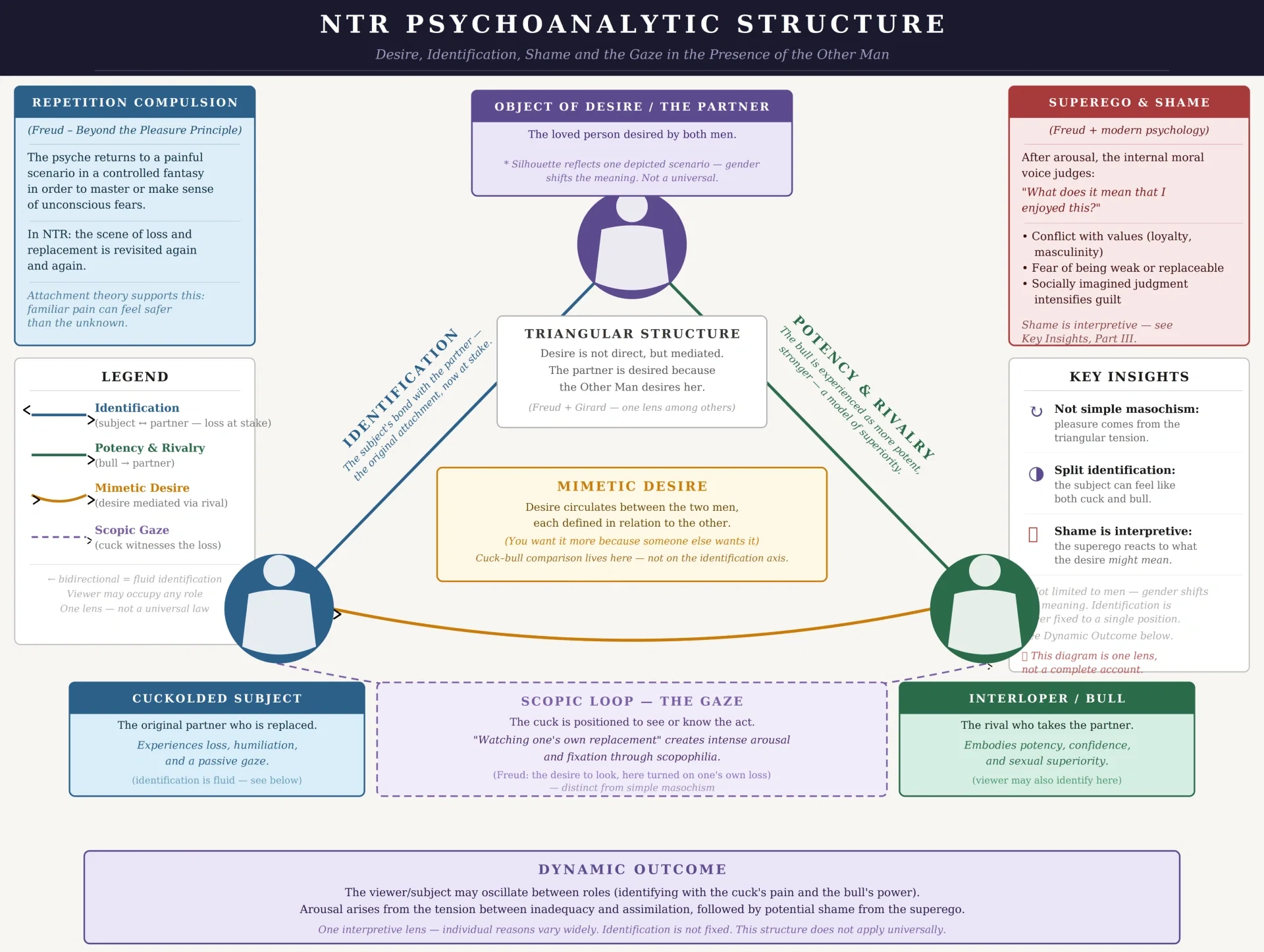
I asked Claude to make a better image than mine, because the one I drew in PowerPoint with text tabs and mouse was ass. If y’all want to see it, I will provide it.
LINK TO MY PDF: https://files.catbox.moe/d5q1fm.pdf
Desire, Shame, and the Other Man: A Freudian Reading of NTR
Netorare (NTR) is a genre of erotic fiction from Japanese manga and visual novels, built around a committed partner being taken by someone else, usually while the original partner watches or finds out. It's one of the more psychologically loaded genres in contemporary erotic media, and also one of the most popular. That combination seems worth looking at more closely. What might be going on in the mind of someone who engages with NTR?
This article is about one possible psychological lens. It's not trying to explain every reason someone might engage with NTR. People come to it through novelty, taboo, voyeurism, conditioning, all sorts of things. What follows is one way of reading a specific pattern that shows up fairly often.
Part I: The Compulsion Structure, or Why It Hurts and You Keep Coming Back
Sigmund Freud's idea of repetition compulsion, from Beyond the Pleasure Principle, is about how the mind keeps returning to unpleasant experiences. Not because a person enjoys pain exactly, but because the mind seems to be trying, without quite knowing it, to work through something unresovled. The classic example is the child's fort-da game, throwing a toy away and pulling it back again and again, rehearsing loss to get some handle on it.
(yes, this already sounds SO dramatic, but stay with me)
NTR fits this pattern pretty well. In these stories someone loses a person they love, watches it happen, can't stop it. The viewer can identify with different characters but often lands with the one being hurt. And the genre keeps returning to that same situation of replacement, of being left behind. In Freudian terms that's not just masochism. It can be read as a way of going back over fears about not being enough, about being abandoned, trying to make some sense of them.
(basically: it hurts, but it's a familiar kind of hurt)
Attachment theory points in a
...